
Multi Vendor Hardware Monitoring, Without Blind Spots
Monitor and control servers, storage, network devices, BMC interfaces, power, cooling, and data center environment systems in one unified out of band platform.
Sensaka DCOS is built for mixed vendor data centers where infrastructure teams manage Dell, HPE, Lenovo, Cisco, Huawei, Supermicro, storage arrays, switches, UPS, cooling systems, and other physical devices together. Instead of relying on fragmented vendor tools, OS agents, or partial SNMP coverage, Sensaka DCOS gives teams unified hardware level visibility across the physical infrastructure that keeps business services running.
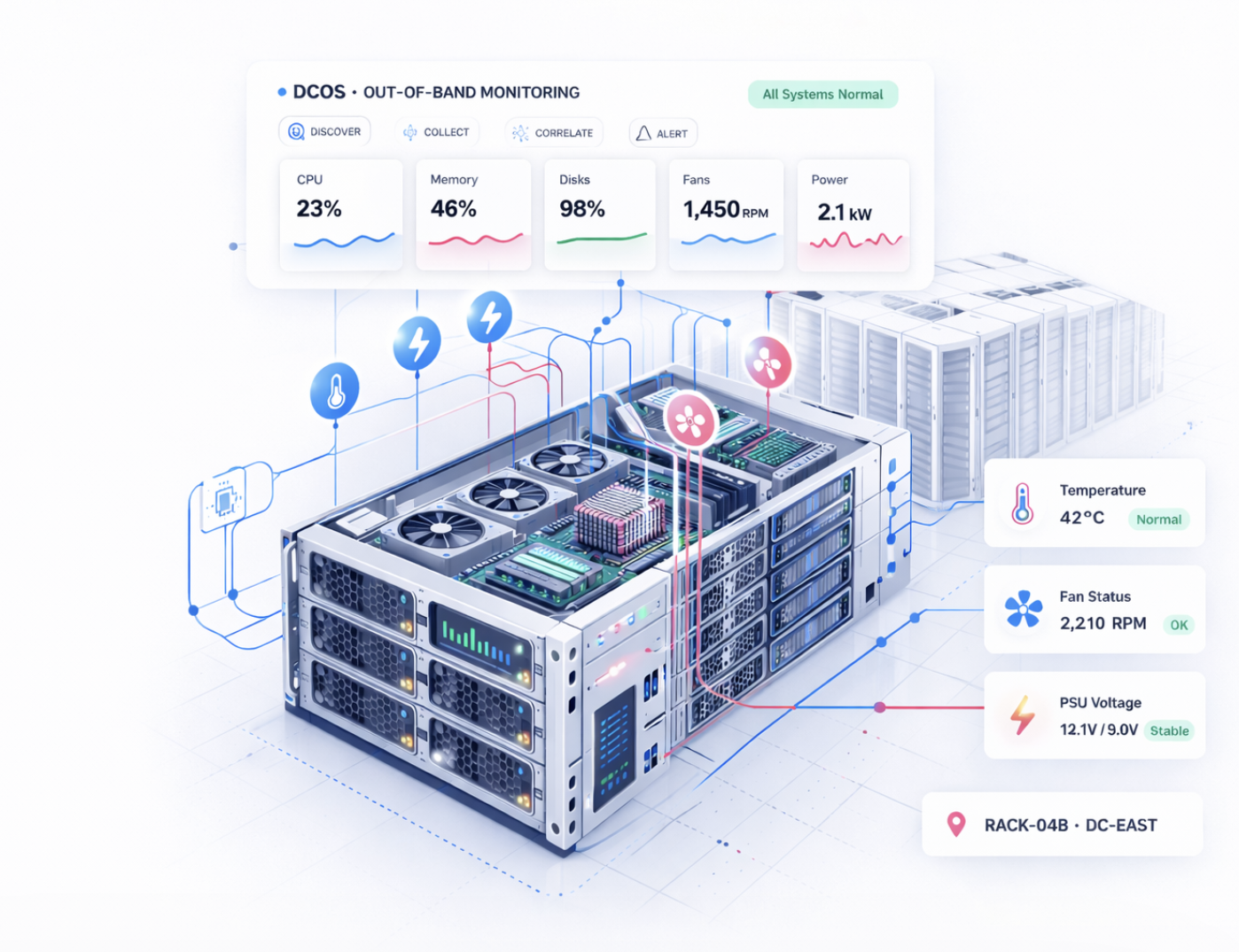
Why Traditional Hardware Monitoring Falls Short
Most hardware monitoring tools were not designed for today's mixed vendor data centers. They often depend on operating system agents, vendor specific consoles, partial SNMP coverage, or manual inspection. That creates operational blind spots when teams need visibility most.
That is why many infrastructure teams still discover failed fans, degrading power supplies, thermal issues, controller faults, disk risks, or component drift only after performance drops, users complain, or business systems are already affected.
Mixed Hardware, Fragmented Tools
Real data centers are not single vendor environments. A typical enterprise may run multiple server brands, storage platforms, network devices, security appliances, UPS systems, PDUs, and cooling systems across several rooms, racks, or sites.
Each layer often has its own console, login, data model, monitoring method, and operational language. Server teams look at BMC tools. Storage teams check storage consoles. Network teams use network monitoring tools. Facilities teams watch power and cooling. When something goes wrong, no one has a complete hardware level view.
Sensaka DCOS helps unify this fragmented model with:
This gives infrastructure teams one operating view across the devices that directly affect uptime, capacity, resilience, and service continuity.
A Unified Multi Vendor BMC Management Platform
Sensaka DCOS connects directly to hardware management interfaces including BMC, IPMI, Redfish, iLO, iDRAC, iBMC, IMM, and other vendor specific management interfaces. It collects hardware health, power, temperature, configuration, and control data at the component level without installing software inside the operating system.
This makes Sensaka DCOS more than a hardware monitor. It is a unified BMC management platform for teams that need to manage mixed server environments without switching between separate vendor consoles.
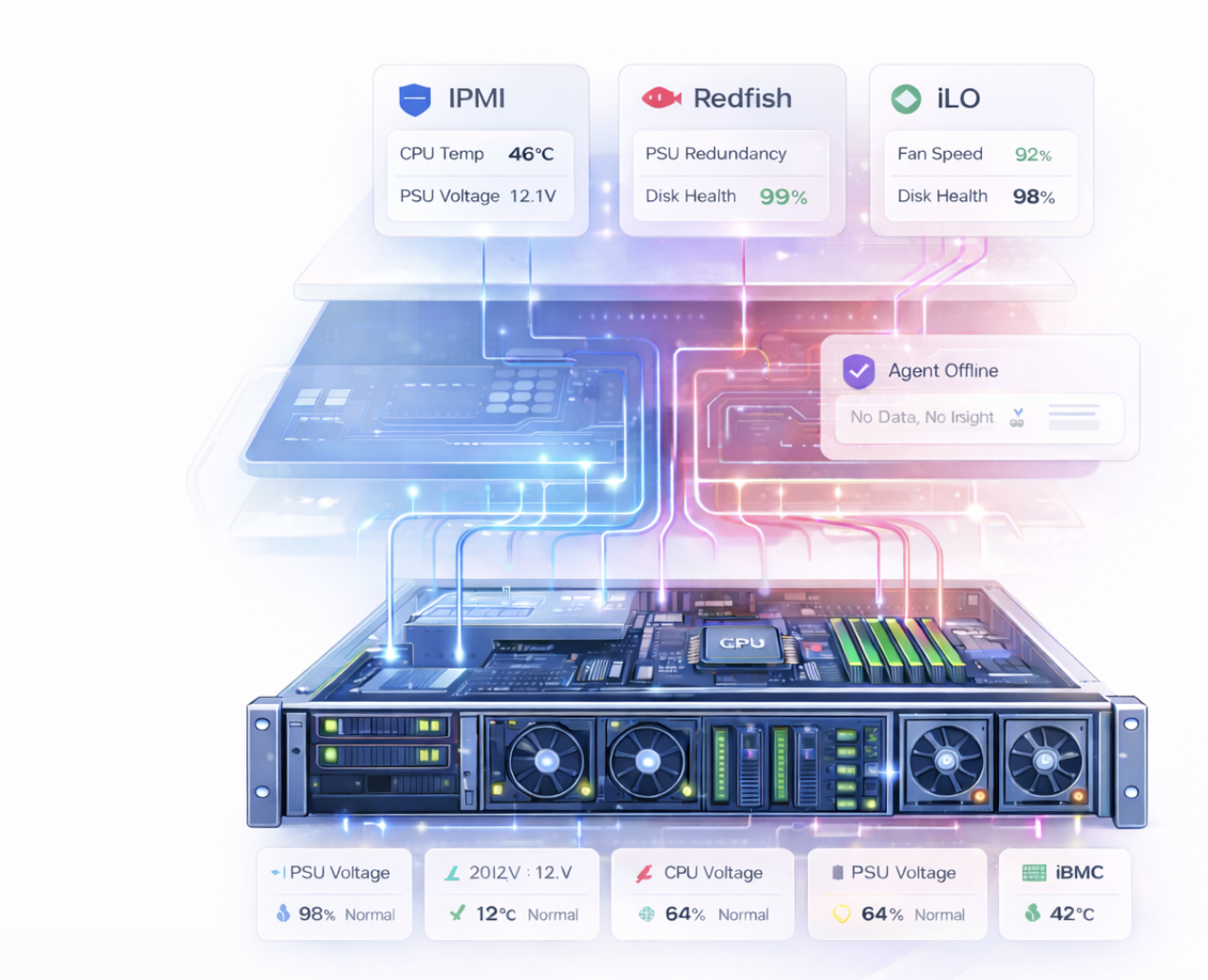
Multi Vendor Server BMC Management
Manage hardware visibility across multiple server vendors, generations, and management interfaces from one platform.
Component Level Fault Detection
Detect risks across disks, RAID controllers, fans, power supplies, memory, processors, NICs, sensors, logs, and other hardware components.
Unified Alerting
Consolidate hardware alerts from servers, storage, network devices, power, and environment systems into one operational view.
Remote Access and Control
Use remote power control, KVM, BIOS access, virtual media, and troubleshooting workflows across distributed sites.
Hardware Asset Lifecycle Tracking
Track configuration, component changes, warranty, location, lifecycle status, and hardware drift with less manual effort.
Power and Environment Visibility
Monitor power consumption, inlet and outlet temperature, UPS, PDU, cooling, humidity, and related physical risk signals.
Monitor Hardware Even When the OS Is Down
A hardware monitor is most valuable when software visibility fails. Sensaka DCOS continues to monitor the hardware layer even when the operating system has stopped responding, the host is powered off, or the application stack is unavailable.
Because Sensaka DCOS uses out of band access, infrastructure teams can keep hardware visibility even during OS crashes, agent failures, network isolation, and remote incident response.
Detect and investigate:
Remote hardware functions:
Control the Hardware Too
Most monitoring tools stop at telling you something is wrong. Sensaka DCOS goes further by giving operations teams the ability to act at the hardware level.
With unified BMC access and out of band control, teams can remotely investigate, restart, access, and recover hardware without waiting for on site intervention. This reduces dependency on crash carts, manual BMC login, and fragmented vendor workflows.
For distributed data centers, colocation environments, financial institutions, telecom operators, and AI infrastructure teams, this control layer is essential. The question is not only "what failed?" It is also "can we act quickly from the same platform?"
Unified Visibility Across Servers, Storage, and Network Devices
Sensaka DCOS helps teams monitor the full physical infrastructure that affects service continuity. It is not limited to servers. It gives teams a unified view across server hardware, storage devices, network devices, security devices, power, cooling, and data center environment systems.
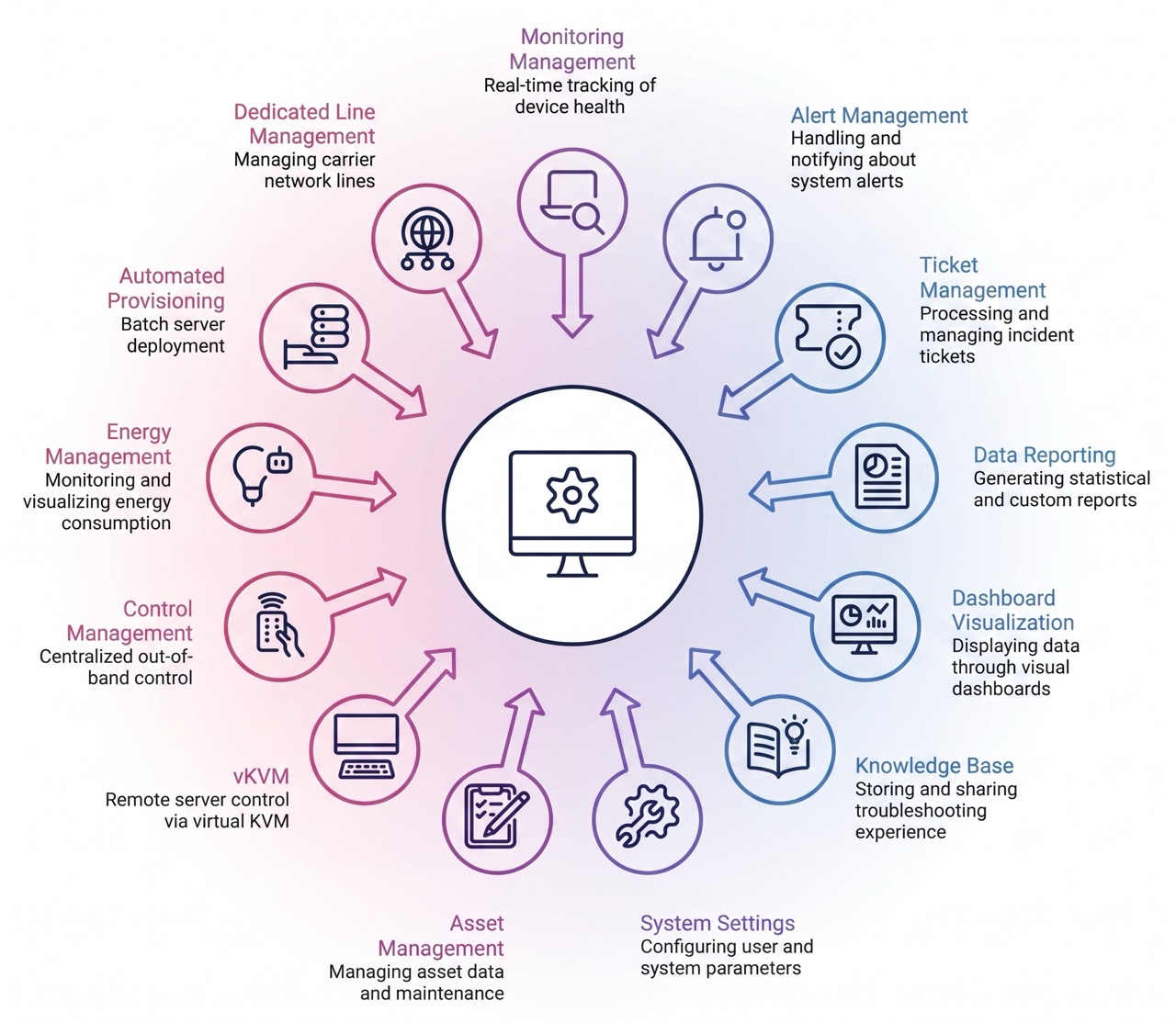
Servers
Monitor multi vendor servers across component health, disks, RAID controllers, fans, power supplies, temperature sensors, processors, memory, NICs, logs, BMC interfaces, and other critical hardware signals.
Storage
Monitor storage arrays, controllers, disk enclosures, ports, volumes, pools, fans, power supplies, cache, capacity signals, and hardware indicators outside traditional server monitoring.
Network Devices
Monitor switches, routers, load balancers, firewalls, fiber switches, optical modules, power supplies, fans, ports, and device health signals that affect infrastructure reliability.
Power and Environment
Monitor UPS, PDU, precision cooling, temperature, humidity, and related environment systems that directly influence hardware reliability, power safety, and thermal risk.
Security and Facility Devices
Extend monitoring to security appliances, access control, environmental sensors, and other physical infrastructure devices where supported.
Why Sensaka DCOS Is Different
Built for Mixed Vendor Data Centers
Designed for environments where multiple server, storage, network, and facility device brands operate together.
Out of Band by Design
Monitoring does not depend on the operating system, application stack, or agent health.
Unified BMC Management
Teams can reduce tool fragmentation by centralizing BMC based hardware visibility and control.
Beyond Server Monitoring
Covers servers, storage, network devices, power, cooling, and environment systems in one platform.
Hardware Level Accuracy
Component level visibility helps teams detect real hardware risks, configuration drift, and asset changes with greater precision.
Practical Operations Control
Remote KVM, power control, BIOS access, virtual media, and batch control help teams shorten incident response time.
Built for High Value Data Centers
Sensaka DCOS is designed for organizations where downtime, hardware drift, delayed fault detection, and manual infrastructure operations have real operational and financial consequences.
What You Gain with Sensaka DCOS
Increase Uptime
Detect hardware risks before they become service disruptions.
Reduce MTTR
Use precise hardware diagnostics, centralized alerts, and remote control to shorten incident resolution time.
Eliminate Blind Spots
Keep visibility even when the operating system is unavailable or an agent is not running.
Simplify Multi Vendor Operations
Replace fragmented server, storage, network, and BMC tools with one unified hardware monitoring approach.
Improve Asset Accuracy
Track hardware configuration, component changes, lifecycle status, and location data with less manual effort.
Strengthen Resilience
Monitor power, cooling, temperature, and environment signals before small hardware issues become larger outages.
Improve Operational Control
Give teams the ability to remotely access, control, restart, and troubleshoot hardware across sites.
Frequently Asked Questions
What is hardware monitoring?
Hardware monitoring is the process of tracking the health, status, configuration, and risk signals of physical infrastructure components such as disks, fans, power supplies, processors, memory, RAID controllers, temperature sensors, storage arrays, switches, UPS systems, and cooling equipment.
What is multi vendor hardware monitoring?
Multi vendor hardware monitoring means monitoring hardware from different brands, device types, and generations in one platform. In a data center, this often includes servers, storage, network devices, BMC interfaces, power systems, and environment systems from many different vendors.
What makes Sensaka DCOS different from a typical hardware monitor?
Most tools depend on OS agents, partial SNMP data, or vendor specific consoles. Sensaka DCOS uses out of band hardware access to collect data directly from management interfaces, so monitoring can continue even when the operating system is unavailable.
Is Sensaka DCOS a BMC management platform?
Yes. Sensaka DCOS provides unified multi vendor BMC management by connecting to hardware management interfaces such as BMC, IPMI, Redfish, iLO, iDRAC, iBMC, IMM, and related vendor interfaces.
Can Sensaka DCOS manage multiple hardware brands?
Yes. Sensaka DCOS is designed for mixed vendor environments where infrastructure teams need to monitor and manage hardware across different server, storage, network, and data center device brands.
Is Sensaka DCOS only for server monitoring?
No. Sensaka DCOS can cover servers, storage devices, network devices, security devices, UPS, PDU, cooling, temperature, humidity, and other physical infrastructure systems in one platform.
Can Sensaka DCOS monitor hardware when the OS is down?
Yes. Because Sensaka DCOS uses out of band access, it can continue to monitor the hardware layer even when the operating system is down, powered off, frozen, or unreachable.
Who should use Sensaka DCOS?
Sensaka DCOS is best suited for medium to large organizations with complex infrastructure, mixed hardware vendors, distributed sites, high uptime requirements, or teams that need unified hardware visibility and remote control.
Ready to Modernize Multi Vendor Hardware Monitoring?
Sensaka DCOS helps infrastructure teams move from fragmented, reactive hardware monitoring to a unified, out of band operating model across servers, storage, network devices, BMC interfaces, power, cooling, and data center environment systems.
Request an Online TrialSensaka DCOS provides multi vendor hardware monitoring, unified BMC management, and server storage network device visibility for modern data centers.
Related: DCOS, multi-vendor BMC monitoring, out-of-band monitoring, and GPU infrastructure monitoring.
By vendor controller: Dell iDRAC, HPE iLO, Huawei iBMC, Lenovo XCC, and Supermicro IPMI. Guides: Hardware Lifecycle Management and Preventing Hardware Failures.
References: out-of-band management and IPMI.