
Data Center Observability, Without Silos
Gain full visibility across your entire data center with Sensaka. Monitor hardware, network, storage, and environment systems in one unified platform, without fragmented tools or blind spots.
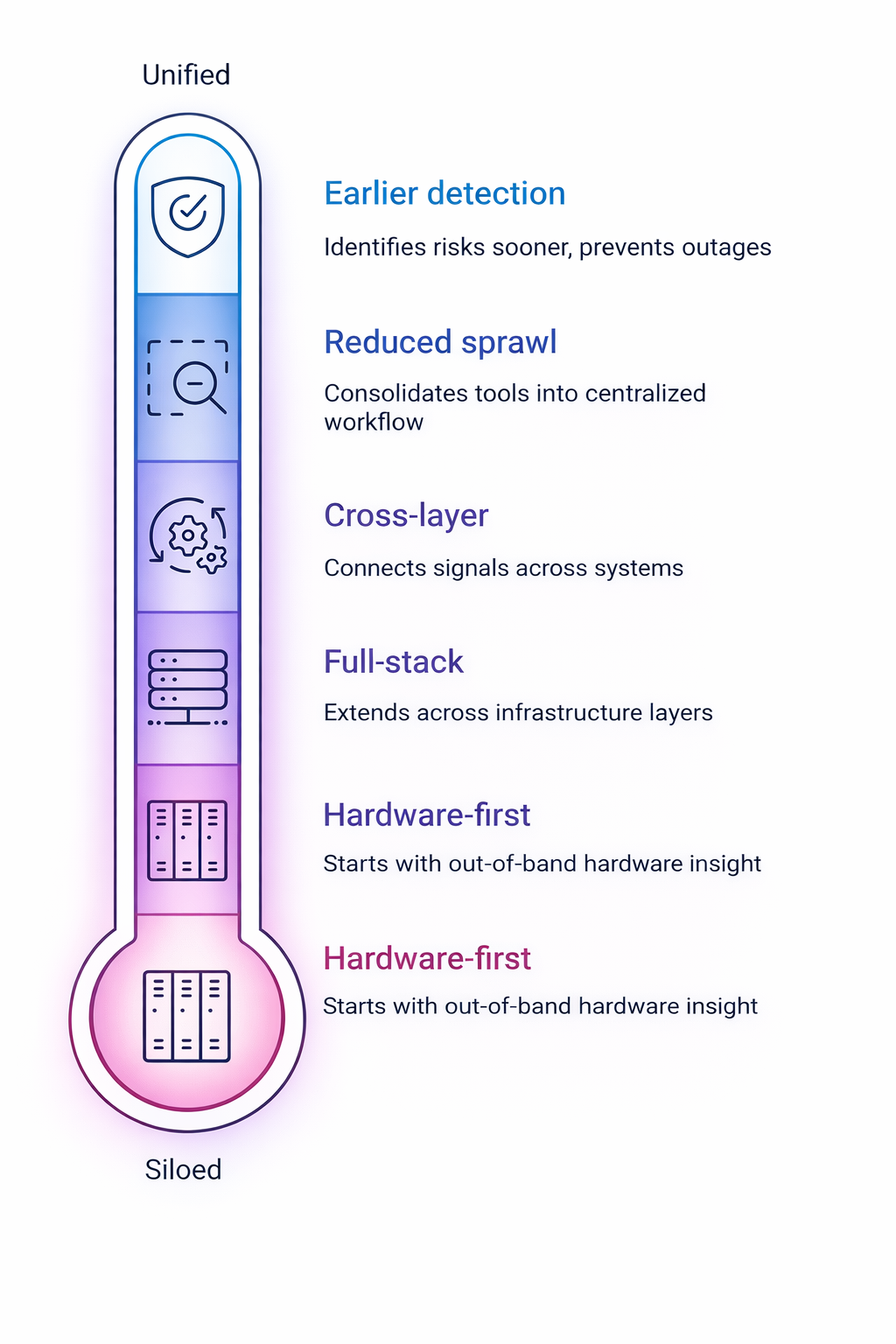
Traditional data center monitoring was built in silos. Servers, networks, storage, and facilities are monitored separately, using different tools, different dashboards, and different data models. Sensaka changes this by delivering unified data center observability across all layers of infrastructure.
From Monitoring Silos to Unified Visibility
Traditional data center monitoring was built in silos. Servers, networks, storage, and facilities are monitored separately, using different tools, different dashboards, and different data models.
Sensaka changes this by delivering unified data center observability across all layers of infrastructure — one platform, one operational view.
Why Data Center Monitoring Breaks at Scale
As data centers grow, complexity increases faster than visibility. Most organizations rely on multiple tools — server monitoring, network systems, storage platforms, and DCIM tools — each providing partial visibility but none providing a complete picture.
Traditional Approach vs. Sensaka
Traditional Approach
With Sensaka
Full-Stack Observability Across the Data Center
Sensaka provides deep visibility across every layer of your infrastructure.
Hardware Layer (DCOS)
Monitor server components such as disks, fans, power supplies, temperature, and CPU at the hardware level using out-of-band access.
Network Layer (iDCOS)
Monitor switches, routers, firewalls, and traffic behavior. Visualize topology and detect network-level anomalies.
Storage Layer (DCOS + iDCOS)
Track storage capacity, performance, and health across arrays, volumes, and SAN infrastructure.
Environment Layer (iDCOS DCIM)
Monitor UPS, PDU, cooling systems, temperature, humidity, and other environmental factors that impact infrastructure reliability.
Explore each layer: hardware monitoring and out-of-band monitoring for the server layer, storage monitoring for arrays and SAN, and the iDCOS platform for network, DCIM, and environmental visibility.
Correlate Events Across Infrastructure Layers
Most monitoring tools stop at collecting metrics. Sensaka connects them. When an issue occurs, Sensaka helps you understand which layer is affected and how components are related.
A storage latency spike can be traced to a failing disk, a congested network path, or a power fluctuation.
Sensaka helps correlate signals across infrastructure layers, reducing guesswork and speeding up root cause identification.
Reduce Tool Sprawl and Operational Complexity
Data center teams often operate with 3 to 5 different monitoring tools. Sensaka can replace or consolidate multiple monitoring tools into a unified platform.
Detect Issues Faster, Resolve Sooner
With unified observability, teams can address the actual source of problems instead of reacting to symptoms.
Built for Modern Data Centers
Sensaka is designed for environments where complexity is the norm. In these environments, observability must go beyond surface-level metrics.
What You Gain with Data Center Observability
Faster Root Cause Analysis
Understand how issues propagate across infrastructure layers.
Reduced Alert Noise
Correlate events and eliminate duplicate alerts.
Improved Operational Efficiency
Work from a single platform instead of multiple tools.
Better Infrastructure Visibility
See the full picture across hardware, network, storage, and environment.
Higher Service Reliability
Prevent issues from escalating into outages.
Go Deeper on Data Center Observability
Learn more about the tools and concepts behind unified observability: data center monitoring software, DCIM software comparison, what is AIOps, and what is data center management.
Frequently Asked Questions
What is data center observability?
Data center observability is the ability to monitor, understand, and correlate data across all layers of infrastructure, including hardware, network, storage, and environment systems.
How is observability different from monitoring?
Monitoring collects metrics and alerts. Observability connects those signals across systems to provide context and enable faster root cause analysis.
Does Sensaka replace existing monitoring tools?
Yes. Sensaka is designed to replace multiple infrastructure monitoring tools with a unified platform.
Is Sensaka suitable for multi-vendor environments?
Yes. Sensaka supports heterogeneous environments and provides consistent visibility across different vendors and technologies.
Can Sensaka support large-scale data centers?
Yes. It is designed for complex, large-scale environments.
Ready to Achieve Full Data Center Observability?
Sensaka helps organizations move from fragmented monitoring to unified data center observability. If you want a complete view of your infrastructure and faster control over incidents, Sensaka is the right place to start.
Request an Online TrialReferences: data center and out-of-band management.