
Help desk jobs after AI: postings down 49 % in the US and 70 % in the UK, headcount up
Employers stopped hiring into the service desk and let turnover shrink it. The jobs that remain got harder.
Part of the AI-era IT jobs series. Start with CIO and IT manager jobs grew 26 %. The managers under them got cut..
Indeed's index of IT operations and helpdesk job ads fell 49 % in the US and 70 % in the UK between October 2022 and September 2026 [Indeed via FRED, 2026]. Over roughly the same years, the number of people employed as computer user support specialists in the US rose from 696,830 to 717,190 [BLS OEWS, 2025]. Employers mostly did not swap their help desks for chatbots. They stopped hiring into them, left seats empty when people quit, and handed the people who stayed the harder tickets. If you already work on a desk, that is survivable. If you want your first IT job, the door is much narrower than it was in 2022.
Ads halved, employment grew
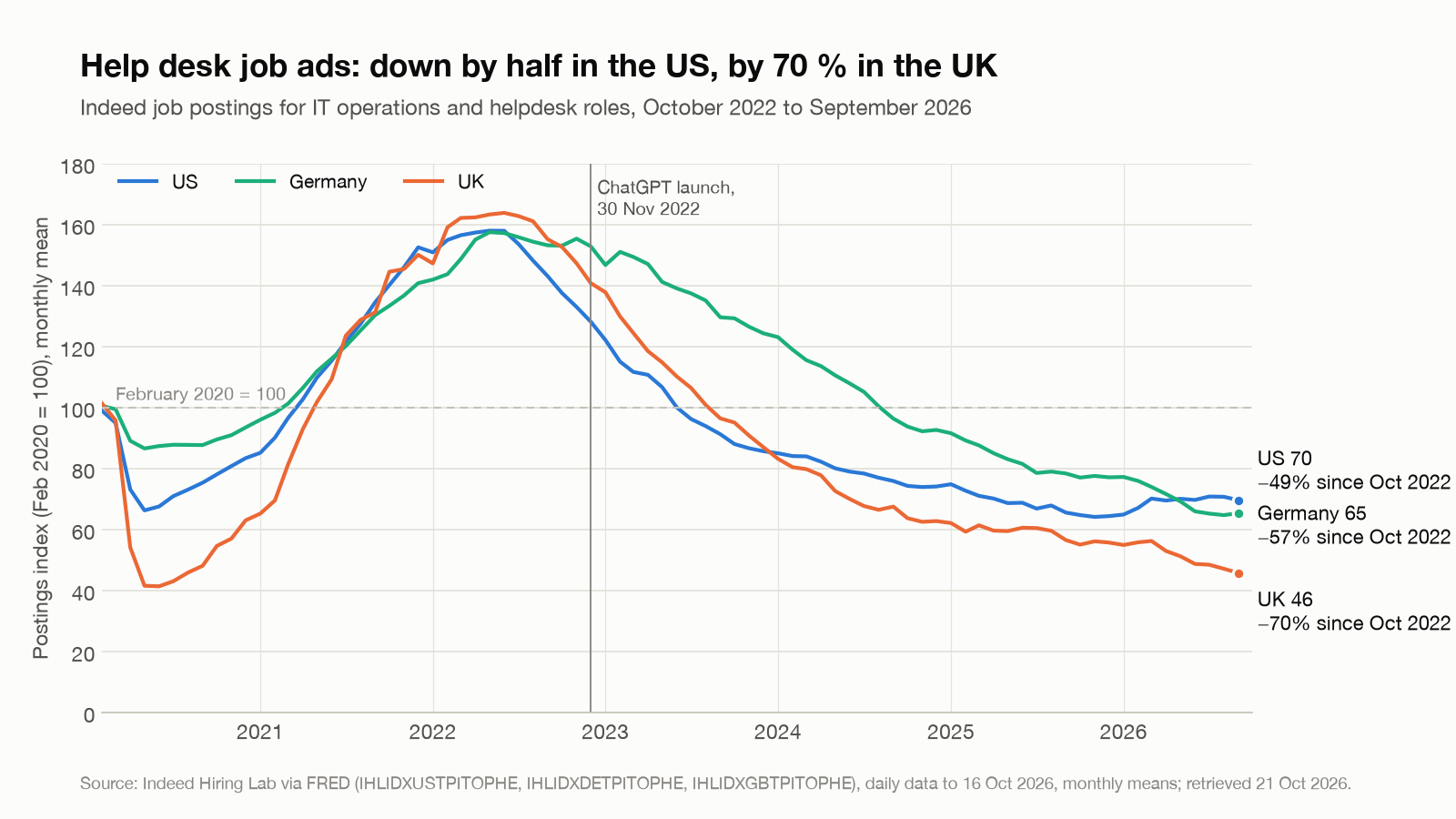
Helpdesk postings peaked in mid-2022 in the US, the UK and Germany, and in spring 2023 in France, and have fallen since. The US index went from 138 in October 2022 to 70 in September 2026, Germany from 153 to 65 and the UK from 153 to 46. France is at 63 [Indeed via FRED, 2026].
Most of the 2022 and 2023 fall was the interest-rate cycle. Every Indeed category dropped in those two years, software as much as support, as rates rose and pandemic hiring unwound. What looks like an AI effect comes after 2024, and it splits by region: in the twelve months to September 2026 the US helpdesk index rose 6 %, while Germany's fell 17 %, the UK's 19 % and France's almost 20 % [Indeed via FRED, 2026]. UK customer-service postings, the nearest cousin of the IT desk, are at 37, a quarter of their October 2022 level.
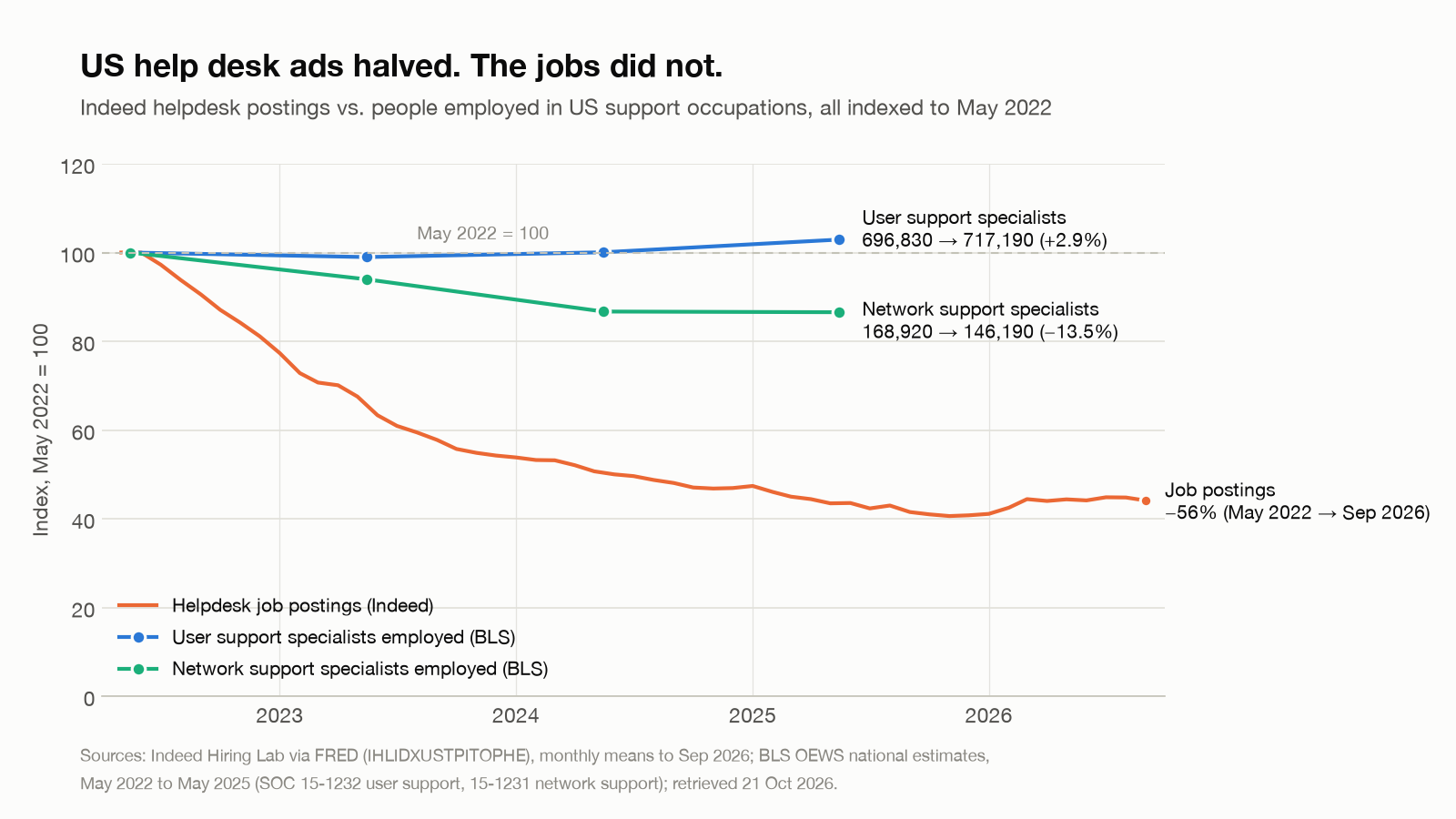
The US Bureau of Labor Statistics counted 696,830 user support specialists in May 2022 and 717,190 in May 2025, up 2.9 % [BLS OEWS, 2025]. Network support, the hands-on layer just above the desk, shrank from 168,920 to 146,190, down 13.5 %.
Turnover explains most of the gap. MetricNet put annual service-desk analyst turnover at 43.1 % in 2023 [MetricNet, 2023], so a desk used to post a lot of ads just to stay the same size. When an employer stops backfilling, the ads disappear long before the headcount does. Employers say that is what they are doing: in April 2026, 63 % of service leaders told Gartner they were shrinking frontline staff through attrition [Gartner, 2026]. Most of that came after the May 2025 employment count, and BLS already projects user-support employment 3.5 % lower over its ten-year horizon [BLS projections, 2025].
Poland shows where some of the work went. Its business-services centres, where many Western European employers run outsourced and shared service desks, grew from 435,300 employees in early 2023 to 488,700 in early 2025 [ABSL, 2025]. That growth has become selective. Kraków's outsourcing (BPO) centres had announced 4,195 planned layoffs by the end of October 2025 [Outsource Accelerator, 2025]. Hays's Polish guide puts 2nd-line support at 11,000 PLN a month in 2025 against 10,000 in 2022 [Hays Poland, 2022 and 2025], a raise that falls short of Polish inflation over those three years.
What the bots took
The tasks that left the desk are the ones you would guess: password resets, account unlocks, first triage and finding the known fix. That erosion started well before ChatGPT. MetricNet found that the share of desktop tickets level 1 could resolve fell from 36.1 % in 2010 to 13.3 % in 2023 [MetricNet, 2023] as self-service portals and remote tools took the easy work, and generative AI is speeding up that old trend.
The measured speed-up is modest. The one large field experiment, on 5,179 customer-support agents at a software company, found 14 % more issues resolved per hour with an AI assistant and 34 % more for the least experienced agents [Brynjolfsson, Li and Raymond, 2023]. A Danish study that included IT support specialists among 25,000 surveyed workers found the tools saved 2.8 % of working hours and changed neither earnings nor hours [Humlum and Vestergaard, 2025].
Vendors report far higher numbers. ServiceNow says its AI agents resolve 90 % of its own internal IT requests [ServiceNow, 2025]. Freshworks reported 40 % of IT requests resolved in its beta [Freshworks, 2024], Atera says up to 40 % of IT workloads [Atera, 2025], and Intercom says its Fin agent resolves 66 % on average across 6,000 customers [diginomica, 2025]. None of them publishes a denominator I can check. After years on the vendor side, my first question about any "resolved" figure is who counted it and over what window. I treat these as the ceiling a well-run deployment with a clean knowledge base can reach.
The job ads show what is left for people. On company job pages for support roles, phone support was mentioned in 14.7 % of ads in late 2022 and early 2023 and in 8.0 % in 2026. Logs and debugging went from 11.2 % to 23.0 %, SLAs from 11.9 % to 21.5 % and "ownership" from 25.5 % to 51.7 % [job-page analysis, 2026]. Desks take fewer calls and harder tickets, and the analyst is expected to own each one to the end. Some ads name the new duty outright: an OutSystems posting for an "AI-native service desk specialist" makes the hire the main author of the knowledge base the assistant answers from [OutSystems job posting, 2026].
The replacement stories, and how they ended
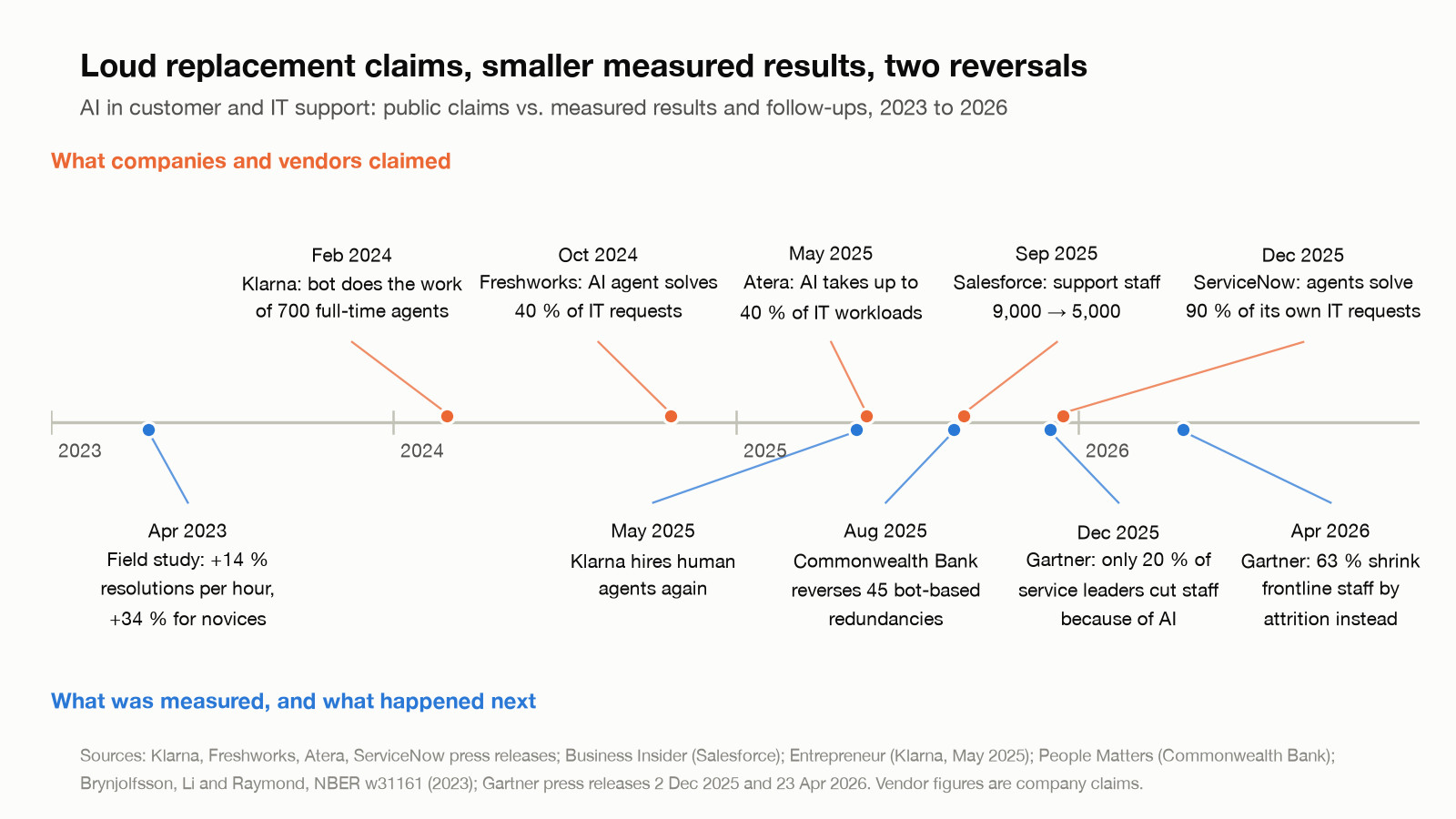
Three companies said publicly that AI had replaced support staff. Klarna announced in February 2024 that its assistant had handled 2.3 million conversations in its first month, two thirds of its chats, "the equivalent work of 700 full-time agents" [Klarna, 2024]. By May 2025 its CEO said quality had suffered and the company was hiring human agents again [Entrepreneur, 2025]. Commonwealth Bank of Australia cut 45 customer-service roles on the strength of a voice bot in 2025 and reversed the decision within weeks [People Matters, 2025]. Salesforce is the one that stuck: Marc Benioff said support went from about 9,000 people to about 5,000, and the company said it no longer needed to actively backfill support engineer roles [Business Insider, 2025].
Gartner's surveys of service leaders put these stories in proportion. In late 2025 only 20 % had cut agent headcount because of AI, while 55 % kept staffing flat and handled more volume [Gartner, 2025]. By April 2026, 85 % were adding duties to the agents they kept [Gartner, 2026]. Gartner also expects half of the organisations that planned large AI-driven service cuts to drop those plans by 2027 [Gartner, 2025]. Klarna and Commonwealth Bank announced a cut, overshot and backed off. Most employers skip the announcement and shrink through attrition.
Who pays: the people still outside
Stanford's payroll study finds employment of 22- to 25-year-olds in the most AI-exposed occupations, customer service among them, 19 % below the path of their less-exposed peers by mid-2026. The authors trace the gap to fewer hires rather than more separations [Brynjolfsson, Chandar and Chen, 2026]. On r/helpdesk this month a new IT graduate with a CompTIA A+ described more than a hundred applications and no offer [Reddit, 2026], and the same week an MSP advertised first-line phone support at $13 an hour [Reddit, 2026].
Pay for those inside has slipped too. The US median wage for user support rose from $57,890 in 2022 to $61,860 in 2025, which after 10.1 % inflation is a 2.9 % cut in real terms [BLS OEWS, 2025].
The field experiment points the other way. The assistant helped novices most, so it makes a junior useful sooner. Many employers have drawn the opposite lesson and now hire fewer novices. Cutting the junior seat to pay for the licence removes the person the tool helps most, and with that person your future second and third line.
What this means if you work in IT support
- If you are trying to get in, aim at work a chatbot can't do: deskside, endpoint management and identity. Bring one thing you automated yourself, because a certificate with nothing next to it is the profile that collects a hundred rejections.
- If you are on a desk, take ownership of the knowledge base and the assistant. Write and maintain the content the bot answers from, and check what it gets wrong. In 2026 ads, that is the support role with a title and a budget.
- Move toward the escalation queue. Logs and debugging doubled in support ads, SLAs nearly did, and phone work fell by almost half. Learn to read logs, own tickets to the end, and be the person who can tell your manager what the bot really resolves, using numbers you measured yourself.
With fewer first-line hires, the tickets that remain need better context about what is installed where, which is why we tie service desk work to the configuration record in Sensaka's CMDB & ITSM module.
Sources
- Indeed Hiring Lab via FRED, IT Operations & Helpdesk job postings index, US, UK, Germany, France (IHLIDXUSTPITOPHE, IHLIDXGBTPITOPHE, IHLIDXDETPITOPHE, IHLIDXFRTPITOPHE) and UK customer service (IHLIDXGBTPCUSTSERV), data to 16 Oct 2026. https://fred.stlouisfed.org/series/IHLIDXUSTPITOPHE (retrieved 21 Oct 2026)
- US Bureau of Labor Statistics, Occupational Employment and Wage Statistics, national estimates May 2022 and May 2025, SOC 15-1232 and 15-1231. https://www.bls.gov/oes/special-requests/oesm22nat.zip and https://www.bls.gov/oes/special-requests/oesm25nat.zip (retrieved 21 Oct 2026)
- US Bureau of Labor Statistics, Employment Projections, occupation tables, current ten-year edition. https://www.bls.gov/emp/ (retrieved 21 Oct 2026)
- US Bureau of Labor Statistics, CPI-U via FRED (May 2022 to May 2025, +10.1 %). https://fred.stlouisfed.org/series/CPIAUCSL (retrieved 21 Oct 2026)
- MetricNet, "Benchmarking Roundup: Summary of 2023 IT Service and Support Benchmarks", November 2023, pp. 12 and 19. https://www.brighttalk.com/resource/core/447335/benchmarking-roundup---summary-of-2023-service-and-support-benchmarks-v3_954461.pdf
- Gartner, "Gartner Survey Finds 31 Percent of Service and Support Leaders Have Implemented or Are Planning AI-Driven Frontline Layoffs Through 1Q27", 23 Apr 2026. https://www.gartner.com/en/newsroom/press-releases/2026-04-23-gartner-survey-finds-31-percent-of-service-and-support-leaders-have-implemented-or-are-planning-ai-driven-frontline-layoffs-through-1q27
- Gartner, "Gartner Survey Finds Eighty-Five Percent of Service and Support Leaders Are Expanding Human Agent Responsibilities…", 28 Apr 2026. https://www.gartner.com/en/newsroom/press-releases/2026-04-28-gartner-survey-finds-eighty-five-percent-of-service-and-support-leaders-are-expanding-human-agent-responsibilities-despite-expectations-of-mass-ai-layoffs
- Gartner, "Gartner Survey Finds Only 20 Percent of Customer Service Leaders Report AI-Driven Headcount Reduction", 2 Dec 2025. https://www.gartner.com/en/newsroom/press-releases/2025-12-02-gartner-survey-finds-only-20-percent-of-customer-service-leaders-report-ai-driven-headcount-reduction
- Gartner, "Gartner Predicts 50% of Organizations Will Abandon Plans to Reduce Customer Service Workforce Due to AI", 10 Jun 2025. https://www.gartner.com/en/newsroom/press-releases/2025-06-10-gartner-predicts-50-percent-of-organizations-will-abandon-plans-to-reduce-customer-service-workforce-due-to-ai
- ABSL, "Business Services Sector in Poland 2025", June 2025. https://invest.lodz.pl/files/invest/public/ABSL-2025-EN.pdf
- Outsource Accelerator (relaying Bloomberg), Kraków BPO planned layoffs, November 2025. https://news.outsourceaccelerator.com/polands-krakow-bpo-jobs/
- Hays Poland, "Raport płacowy 2022" and "Raport płacowy 2025", IT and telecoms tables. https://image.email.hays.com/lib/fe4515707564057c751477/m/5/68f1952e-6691-4478-aba5-0343337a1b6e.pdf and https://image.email.hays.com/lib/fe4515707564057c751477/m/1/1bf98f67-6a88-4a85-89a9-811235507714.pdf
- Brynjolfsson, Li and Raymond, "Generative AI at Work", NBER Working Paper 31161, April 2023. https://www.nber.org/papers/w31161
- Humlum and Vestergaard, "Large Language Models, Small Labor Market Effects", BFI Working Paper 2025-56, May 2025. https://bfi.uchicago.edu/wp-content/uploads/2025/04/BFI_WP_2025-56-3.pdf
- Brynjolfsson, Chandar and Chen, "Canaries in the Coal Mine?", Stanford Digital Economy Lab, August 2026 revision. https://digitaleconomy.stanford.edu/app/uploads/2026/08/Canaries_August2026.pdf
- ServiceNow, "ServiceNow completes acquisition of Moveworks", 15 Dec 2025. https://investor.servicenow.com/news/news-details/2025/ServiceNow-completes-acquisition-of-Moveworks/default.aspx
- Freshworks, "Freshworks unveils easy-to-use AI agent…", 23 Oct 2024. https://www.freshworks.com/press-releases/freshworks-unveils-easy-to-use-ai-agent-to-improve-the-customer-and-employee-experience/
- Atera (PR Newswire via The AI Journal), "Atera Launches IT Autopilot", 20 May 2025. https://aijourn.com/atera-launches-it-autopilot-ushering-in-the-era-of-autonomous-it/
- diginomica, "Intercom announces latest evolution of its AI customer service agent", 17 Oct 2025. https://diginomica.com/intercom-announces-latest-evolution-its-ai-customer-service-agent-just-getting-started
- Klarna, "Klarna AI assistant handles two-thirds of customer service chats in its first month", 27 Feb 2024. https://www.klarna.com/international/press/klarna-ai-assistant-handles-two-thirds-of-customer-service-chats-in-its-first-month/
- Entrepreneur (reporting a Bloomberg interview), "Klarna CEO Reverses Course By Hiring More Humans, Not AI", 9 May 2025. https://www.entrepreneur.com/business-news/klarna-ceo-reverses-course-by-hiring-more-humans-not-ai/491396
- People Matters ANZ, "Commonwealth Bank of Australia reverses plan to cut 45 customer service roles after union challenge", August 2025. https://anz.peoplemattersglobal.com/news/hr-technology/commonwealth-bank-of-australia-reverses-plan-to-cut-45-customer-service-roles-after-union-challenge-46533
- Business Insider (via AOL), "Marc Benioff says Salesforce has cut 4,000 roles in support because of AI agents", 3 Sep 2025. https://www.aol.com/marc-benioff-says-salesforce-cut-054506495.html
- Job-page analysis: support job pages at the same set of companies, 286 open between October 2022 and March 2023 and 688 open between May and October 2026; mostly product and technical support at software companies, about 30 % internal IT. Data and method: ai-era-it-jobs study data.
- OutSystems, "AI-Native Service Desk Specialist" (via DailyRemote), 2026. https://dailyremote.com/remote-job/ai-native-service-desk-specialist-4915803
- Reddit, r/helpdesk, 16 Oct 2026. https://www.reddit.com/r/helpdesk/comments/1x7voh2/i_just_finished_my_bachelors_degree_in_it_i/
- Reddit, r/ITCareerQuestions, 19 Oct 2026. https://www.reddit.com/r/ITCareerQuestions/comments/1xa3m0b/entry_level_opportunity_in_my_area_paying_garbage/
See hardware, power and cooling health from outside the operating system. Request an online trial and explore how Sensaka brings hardware, operations and business services into one platform.
Request an Online Trial →Sensaka AI & GPU Infrastructure Observability
Full-stack thermal, liquid cooling, and BMC hardware monitoring for high-density NVIDIA H100/B200 GPU racks and AI clusters.
Related articles & analysis